
Office Hours
| MON | 11:00 am - | 7:00 pm | |
| TUE | 3:00 pm - | 6:00 pm | |
| WED | 7:00 am - | 7:00 pm | |
| THU | 3:00 pm - | 6:00 pm | |
| FRI | CLOSED | ||
| SAT | 8:00 am - | 11:00 am | |
Office Location

Dr. Steven Meacham, D.C.
1023 Main Plaza Drive
Wentzville, MO 63385
Map and Directions
Contact Info
Social Media
SuperSorb®
Click here to shop the FullScript store
SuperSorb® is BioPharma Scientific's trademark for its enhanced delivery systems designed to promote greater absorption and utilization by the body. Any such benefit is generally described as increased bioavailability.
SuperSorb® Enhanced Delivery Systems currently include:
1. Using forms of phytonutrients and zoonutrients that are more bioavailable.
2. Using forms of vitamins or minerals that are more bioavailable.
3. Using micro-encapsulation to make ingredients more bioavailable.
Number one above is best shown by the phytonutrients quercetin and WellBerry™. Supplemental quercetin it is usually derived from the flavonoid rutin extracted from the seed pods of the Brazilian shrub "fava d'anta" (Dimorphandra mollis). These are treated with acid to obtain quercetin as a very thin powder of greenish yellow color. This commonly found supplemental form of quercetin, however, is poorly absorbed from the gastrointestinal tract. Fortunately, scientists have developed a proprietary procedure for conversion of the inactive precursors in fava beans to the a more biologically absorbable and therefore highly bioactive form called "isoquercetin" AKA isoquercetin/rutin 50/50. This more effective form, though more expensive, is what we use in NanoGreens 10.
NanoReds10® features WellBerry™. Wellberry™ is a combination of proprietary forms of two of nature's most power packed antioxidants; a patented extract of the renowned Ayurvedic superfruit, Indian Gooseberry, also known as amla fruit, and a new, patent pending, highly absorbable form of Vitamin C. The Indian Gooseberry extract contains unique bioactive ingredients that provide greater and longer-lasting antioxidant activity compared to other superfruits sold today. The Vitamin C utilized in Wellberry™ possesses the best absorption and retention rates of any commercial form of Vitamin C available to date due to its patented combination with lipid metabolites and bioflavonoids. This merging of ingredients results in a formulation that provides superior, fast acting, long-lasting antioxidant activity for improved cellular protection.
Number two above is best demonstrated by our use of a more bioavailable form of vitamin B6 in NanOmega 3. The activated form of vitamin B6, pyridoxal-5-phosphate or P-5-P, is the form of vitamin B6 that the body utilizes best. Because a large number of people can't convert vitamin B6 to P-5-P, we use the P-5-P form, the activated form of vitamin B6 in order to support the maximum benefits. Even though it is ten times more expensive, here at BioPharma we think that regardless of what the vitamins may actually cost, the most "expensive" ones are the ones that don't work and cost us our health!
Another example is our use of the natural succinate form of vitamin E in NanOmega3. The succinate form crosses the blood-brain barrier better than other forms of vitamin E. Therefore it is more available as an lipid antioxidant to protect brain cells. Vitamin E succinate is also the best form for breast health as well.
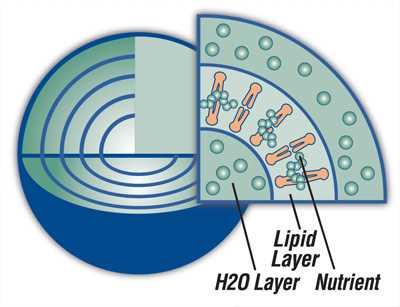
Number three above refers to our natural phospholipid micro-encapsulation process. Indeed, the normal natural human digestion of fats includes our bodies making sub-micron sized "fat bodies", made from phospholipids, especially phosphotidyl choline or PC. They help us absorb nutrients that are not highly bioavailable in water. Though very small,our SuperSorb microencapsulation process is NOT a new nanotechnology.
Why maximizing bioavailability of phytonutrients is of vital importance today.
To quote Jean Mayer of the USDA Human Nutrition, "Research Center on Aging, Tufts University, Boston, MA"...the effort to understand the health benefits of plant foods... is the characterization of their physiologically active constituents, the phytochemicals...As our knowledge grows...we will learn how best to create new products through altering their concentrations, combinations and/or their bioavailability."1
Fruits and vegetables are indeed rich in phytonutrients. However, the quotes below confirm that the bioavailability of phytochemicals can be a challenge to those designing high quality functional foods and phytonutrient supplements.
- "The low solubility of free ellagic acid (a phytonutrient of the organic acid class derived from fruits and nuts, especially raspberries and wild tart cherries) is thought to be due to its low solubility in water." 2
- "the bioavailability of quercetin-3-rutinoside is 17%" 3
- "Bioavailability differs greatly from one polyphenol to another" 4
- "In general,... epicatechins (polyphenols from green tea)... had low bioavailability..." 5
- "Cyclic terpenoids-saponins and phytosterols- have structures similar to ...steroids...(which are) more soluble in oil than water." 6
- "Delivery of natural carotenoids can be compromised by poor bioavailability." 7
- "Consuming tomatoes with oil can increase the bioavailability of lycopene" 8
- "Essentially no absorption of carotenoids was observed when salads with fat-free salad dressing were consumed." 9
The importance of delivery systems when formulating nutraceuticals is further underlined in the Journal of Drug Targeting ,
"...antioxidants, which are found in many phytochemicals,... are biologically unstable, poorly soluble in water, and poorly distributed to target sites... we bly advocate serious consideration of the bioavailability of dietary supplements... to improve their bioavailability using delivery systems…"10